Professional culinary intelligence for people who cook for a living.

The One Egg Dish That Quietly Changed How I Think About Breakfast. Shakshuka
The first time someone described shakshuka to me, I dismissed it.
Eggs cooked in tomato sauce. I’d been poaching eggs since I was teenager and couldn’t see what a can of tomatoes was going to add to the equation.
That was a mistake on my part, and it took longer than I’d like to admit to correct it.
What changed my mind wasn’t a restaurant version or a food magazine spread.
It was a home cook, someone’s grandmother, visiting from outside Tel Aviv, who made it at a gathering I stumbled into in San Francisco.
She used a beat-up pan, dried spices from unmarked jars, and tomatoes from a can with the label half-peeled off.
No ceremony.
She had it on the table in twenty-five minutes and it was the best thing I ate that year.
The spice depth was disorienting. The eggs were impossible, whites set clean, yolks still moving when you broke them.
I asked what she did.
She said she bloomed the spices in oil first, before anything else went in. I’d been adding mine with the tomatoes for years.
Just like that, I understood what I’d been missing.
This shakshuka recipe is built around that lesson. The spice bloom isn’t a dramatic revelation; it’s thirty seconds of patience that changes the entire floor of the dish. The rest is structure and timing, which are the same things every good recipe is ultimately about.
Shakshuka Recipe You Can Bring To The Table For Years To Come
Shakshuka Recipe
Course: Breakfast, Brunch, Dinner, MainCuisine: North African, Middle Eastern, Israeli, Mediterranean, TunisianDifficulty: MediumServings
4
servingsPrep time
10
minutesCooking time
25
minutesCalories
218
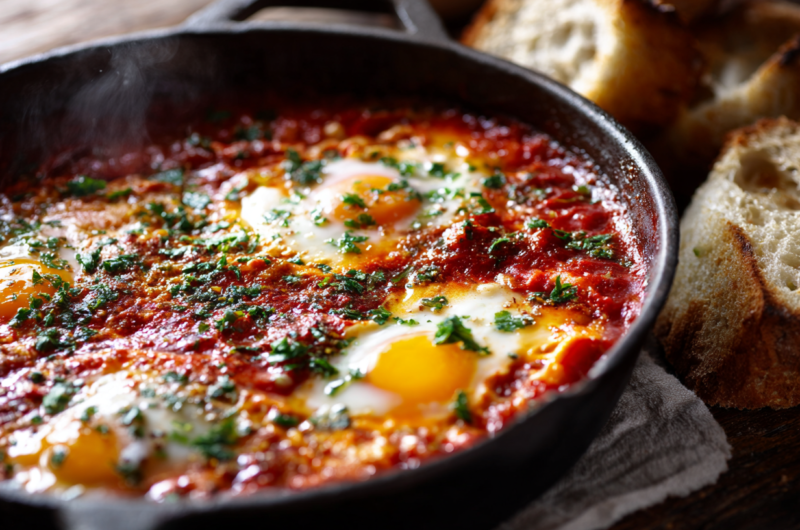
kcalShakshuka is one of those rare dishes that looks like it took real effort but comes together in a single skillet in about half an hour. Eggs gently poached in a chunky, spiced tomato and bell pepper sauce
Ingredients
- For the Sauce
3 tablespoons extra-virgin olive oil
1 teaspoon ground cumin
1 teaspoon sweet paprika (or smoked paprika for a deeper base)
½ teaspoon ground coriander
¼ teaspoon cayenne pepper (adjust to heat preference, or omit)
1 medium yellow onion, diced
1 large red bell pepper, diced
4 cloves garlic, minced
1 tablespoon tomato paste
1 can (28 oz) crushed tomatoes, fire-roasted preferred
½ teaspoon kosher salt, plus more to taste
¼ teaspoon freshly ground black pepper
1 teaspoon granulated sugar (optional, balances acidity)
- For the Eggs
5 to 6 large eggs
- 5 to 6 large eggs
2 tablespoons fresh flat-leaf parsley, roughly chopped
2 tablespoons fresh cilantro, roughly chopped (optional, or use all parsley)
3 oz crumbled feta cheese
Drizzle of extra-virgin olive oil
Warm pita bread or crusty sourdough, for serving
Directions
- Set a large skillet over medium heat and add the olive oil. Let it warm for about a minute — you want it hot enough that a pinch of cumin sizzles when it hits the pan.
- Add the cumin, paprika, coriander, and cayenne directly into the hot oil. Stir constantly for 30 to 45 seconds. The spices will darken slightly and the kitchen will smell incredible. This is the bloom — it wakes up fat-soluble flavor compounds in the spices that would otherwise stay muted inside the sauce. Don’t skip it and don’t walk away from the pan here.
- Add the diced onion and bell pepper to the spiced oil. Cook, stirring occasionally, for 6 to 8 minutes until the onion is soft and translucent and the pepper has some color on the edges.
- Add the garlic and tomato paste. Stir everything together and cook for another 2 minutes. The tomato paste will deepen in color and lose its raw edge — that’s what you’re looking for.
- Pour in the crushed tomatoes and stir well to incorporate all the spiced vegetables into the sauce. Season with salt, black pepper, and the sugar if using. Bring the sauce to a gentle boil, then reduce heat to medium-low.
- Simmer uncovered for 12 to 15 minutes, stirring every few minutes, until the sauce has thickened noticeably and is no longer watery. It should coat the back of a spoon. If it starts sticking to the bottom of the pan, drop the heat a touch.
- Taste and adjust salt. This is the moment — the sauce should taste bold and a little spicy, slightly sweet from the peppers, and deeply savory. Adjust cayenne, salt, or a small pinch more of paprika as needed.
- Use a large spoon to create 5 or 6 shallow wells in the sauce, spacing them out. Crack one egg into each well. Try to get the yolk centered in the well so it cooks evenly.
- Cover the skillet with a lid and cook for 5 to 8 minutes depending on your preference. At 5 minutes the whites are just set and the yolks are completely runny. At 7 to 8 minutes the yolks are jammy and partially set but still soft in the center. Check at 5 minutes — you can always cook longer, you can’t uncook an egg.
- Remove the lid. Scatter the crumbled feta across the top, followed by the fresh parsley and cilantro. Finish with a thin drizzle of olive oil directly over the eggs.
- Bring the skillet straight to the table. Serve immediately with warm pita or thick slices of crusty bread for scooping.
Notes
- The Spice Bloom Is Why This Recipe Does It Differently
Every top shakshuka recipe on the internet follows the same sequence: sauté the vegetables, then add the spices. This recipe reverses that order on purpose. By adding the dry spices directly into the hot oil before the onion and pepper go in, the heat drives off their moisture and activates the fat-soluble aromatic compounds — volatile oils in cumin, paprika, and coriander that are responsible for most of the deep, warm fragrance the dish is known for. When those spices go into a wet pan of vegetables, a lot of that aromatic release gets suppressed. Thirty seconds in hot oil first means those flavors are already fully opened up and coating every vegetable and every drop of tomato sauce from the very start. It is a standard professional technique in Indian and North African cooking and it makes a real, noticeable difference in the finished dish.
The Spices Are the Foundation, Not the Accent
Cumin, paprika, and coriander are the core here, and the order in which you treat them matters.
Cumin has a particular earthiness when dry, warm in the hand, slightly musty, almost dusty.
Add it cold to a pan of wet vegetables and it never fully opens. It mutes.
Paprika behaves the same way: the pigment sits flat and the aroma stays locked.
But drop both into hot olive oil before the onion hits the pan and you get something completely different.
The oil carries the fat-soluble volatile compounds outward, and within thirty seconds the entire pan smells like every good Tunisian kitchen I’ve ever walked past.
Coriander adds a faint citrus lift at the back of that bloom, subtle enough that most people couldn’t name it but obvious in its absence.
The cayenne goes in with the rest of the spices. You’re not trying to make a hot dish , you’re trying to add clean, high heat that sits at the back of the palate without dominating the front.
A quarter teaspoon does exactly that.
The Tomatoes
Fire-roasted crushed tomatoes are worth finding.
The light char reads through the spiced base as a low smokiness that registers as depth rather than a specific flavor, and that kind of layering is what separates a sauce that tastes one-dimensional from one that keeps you reaching for the bread.
Standard crushed tomatoes are fine, the dish works regardless, but the fire-roasted version earns its extra forty cents.
If tomatoes are at their peak, four cups of fresh diced tomatoes plus two tablespoons of tomato paste is the correct move.
Fresh tomatoes bring brightness. They also bring more water, so the simmer runs longer until the sauce tightens up enough to hold an egg.
The tomato paste goes in before the tomatoes, straight against the hot pan with the garlic. Two minutes there drives off the raw acidic edge and concentrates the sweetness.
Don’t skip that step, paste added directly to a wet sauce never loses its metallic bite the same way.
The Eggs Are Not Forgiving
The well technique is straightforward but the timing window is narrow.
Make a depression in the sauce with a large spoon, crack the egg in cleanly, and cover the pan immediately.
From that point on, you’re working against retained heat from the sauce below and steam from the lid above.
At five minutes, the whites are set enough to hold their shape but still tender at the edge, and the yolks are completely liquid.
At seven minutes, the yolks are jammy, moving when you tilt the pan, but not running freely.
At nine minutes, they’re set and that’s fine if that’s what you want, but most people who try this dish once start pulling it off the heat earlier every time after that.
The lid is doing most of the work.
Without it, the steam can’t accumulate, and you end up overcooking the bottom of the white before the top sets at all. A sheet pan works as a makeshift lid in a pinch, just get something flat over that pan.
Scaling and the Crowded-Pan Problem
One recipe feeds four comfortably in a twelve-inch pan.
If you’re feeding more, resist the urge to stack eggs.
The sauce needs surface area to hold the eggs without crowding, and crowded eggs bleed into each other and cook unevenly.
The better approach for a larger group is two pans running simultaneously rather than one overfilled pan. The sauce itself doubles without issue, it’s forgiving in volume, but the egg phase is where the physics turn against you if you push it.
Two pans, same timing, same result. Do that instead.
For make-ahead brunches, the sauce base holds in the refrigerator for four days and freezes cleanly for three months.
Reheat it until it’s actively simmering before the eggs go in. Adding eggs to a lukewarm sauce means they sit there absorbing heat gradually instead of cooking from a precise starting temperature, and the timing becomes unreliable.
What’s Actually in This
One serving, one or two eggs, a generous portion of sauce, a scatter of feta, lands around 215 to 220 calories.
The fat is mostly from olive oil and comes with the full monounsaturated profile that makes this dish genuinely compatible with the way Mediterranean populations actually eat.
The eggs contribute high-quality protein and the tomatoes bring meaningful potassium and vitamin C.
The feta adds sodium, which is also why you salt the sauce carefully before it goes on, feta will finish the seasoning for you. There’s no need to add extra.
Where Substitutions Actually Work
No red bell pepper?
Green works but reads slightly more bitter and vegetal, not wrong, just different.
Orange or yellow bell peppers bring sweetness close to red.
Skip the pepper entirely and the sauce thins and flattens a bit; add an extra tablespoon of tomato paste to compensate.
No fresh parsley? Dried is a downgrade, but a small one.
No feta? A spoonful of labneh or full-fat Greek yogurt dropped on top at serving brings richness and tang in a different register.
Harissa paste, one to two teaspoons stirred into the sauce after the tomatoes, is not a substitution; it’s an upgrade. It’s traditional in Tunisia, and it adds heat and fermented complexity that dried cayenne alone can’t replicate.
A Northern California Note
The farmers’ markets up here run good dry-farmed tomatoes from late July through October, find them in the Mission District, in San Francisco, through San Jose, and into Santa Cruz.
Dry-farmed tomatoes are smaller, denser, lower in water content, and more concentrated in flavor than conventionally irrigated ones.
Drop four cups of those into this sauce during peak season and you won’t need fire-roasted canned anything.
The sauce reduces faster and the flavor is blunt in a way that’s almost startling. It’s the version I make when I’m cooking for people who think they know what this dish tastes like.
7 Questions I Actually Get About Shakshuka
Can I make shakshuka without a lid? Yes. Use a large baking sheet flat over the pan. It traps steam adequately. Results are slightly less even but workable.
Can I add meat? Merguez sausage browned and crumbled into the sauce before the tomatoes is a traditional North African variation. Lamb works the same way. Brown it first, drain excess fat, then build the sauce.
Can I make it dairy-free? Skip the feta. Finish with a drizzle of good olive oil and extra herbs. It stands fine without it.
What pan should I use? Stainless steel or enameled cast iron. Plain cast iron and long-simmered acidic tomato sauce have a slow, corrosive relationship that nobody wants to deal with.
How do I know when the sauce is thick enough? Drag a spoon across the bottom of the pan. If the gap holds for two seconds before closing, the sauce is ready for eggs.
Can I crack eggs into a cup first? Yes, and honestly you should. It gives you one extra second to pull out a shell fragment before it disappears into the sauce. That gap matters.
Is shakshuka actually Israeli? The dish originated in Tunisia. It moved across North Africa and became deeply embedded in Israeli food culture — particularly through the Mizrahi Jewish community — which is why it’s now associated with both. Both claims have history behind them. Eat it either way.
Serve the pan warm, set it on a trivet in the middle of the table, and hand everyone a piece of bread. The sauce moves slowly off the spoon, the yolk breaks when you get to it, and the feta softens against the heat. That’s the whole thing. It doesn’t need explaining once people taste it.